Let me be completely honest with you, because that’s the whole point of this site: sargassum in Playa del Carmen is a serious problem. There are mornings when I walk down to the beach and the turquoise water you saw on Instagram is buried under a brown belt of seaweed that smells like rotten eggs. So it’s advisable to check the sargassum situation on the beach before heading out.
But here’s the other half of the truth, the part most travel content glosses over: sargassum doesn’t have to ruin your trip. It varies wildly from beach to beach and week to week, and the workarounds are simple once you know them. This guide is what I actually check and what I actually do when the sea turns brown.
🌊 What is sargassum and where does it come from?
Sargassum is a free-floating brown macroalgae that lives in the open ocean. In normal quantities it’s a healthy part of the ecosystem - fish and sea turtles use it for shelter. The problem is the quantity.
Since 2011, a so-called Great Atlantic Sargassum Belt has stretched from West Africa all the way to the Gulf of Mexico. Scientists point to warmer oceans and nutrient runoff from rivers like the Amazon. Every spring and summer, winds and currents push chunks of that belt onto the Mexican Caribbean coast.
When tons of it pile up on shore and start decomposing, three things happen:
- The smell: rotting sargassum releases hydrogen sulfide - the rotten-egg odor.
- The color: the water near shore turns brown.
- The damage: it depletes oxygen, stresses coral reefs, and accelerates beach erosion.
📅 Sargassum season: when does it hit?
The general pattern on the Riviera Maya:
| Period | Sargassum level | What to expect |
|---|---|---|
| December - February | Low - the safest window | Beaches almost always clean, though no longer a guarantee |
| March - April | Ramping up | Good days and bad days |
| May - August | 🔴 Peak season | Frequent landings, intensive daily cleanup. You need a plan B |
| September - November | Tapering off | Improving, with occasional episodes on strong east winds |
Important for 2026: this is shaping up to be one of the worst seasons on record. State authorities forecast 120,000-130,000 tons for Quintana Roo, and Playa del Carmen alone has already removed more than 20,000 tons this year. There were even off-season landings - 25 tons on Playa Mamitas in January and over 1,000 tons on El Recodo in February. The winter window is still your best bet, but nothing is guaranteed anymore.
One thing almost nobody tells you: wind matters more than the calendar. Two days of strong easterly wind can bury a beach out of season, and a week of north wind can leave it spotless in the middle of July.
But May, June and the start of July have been horrible. Just now some beaches are finally starting to recover.
🏖️ Current beach conditions (July 2026)
Here’s the situation destination by destination as I write this. Fair warning: this changes daily, so treat it as the big picture and verify on the day of your visit (I’ll show you how below).
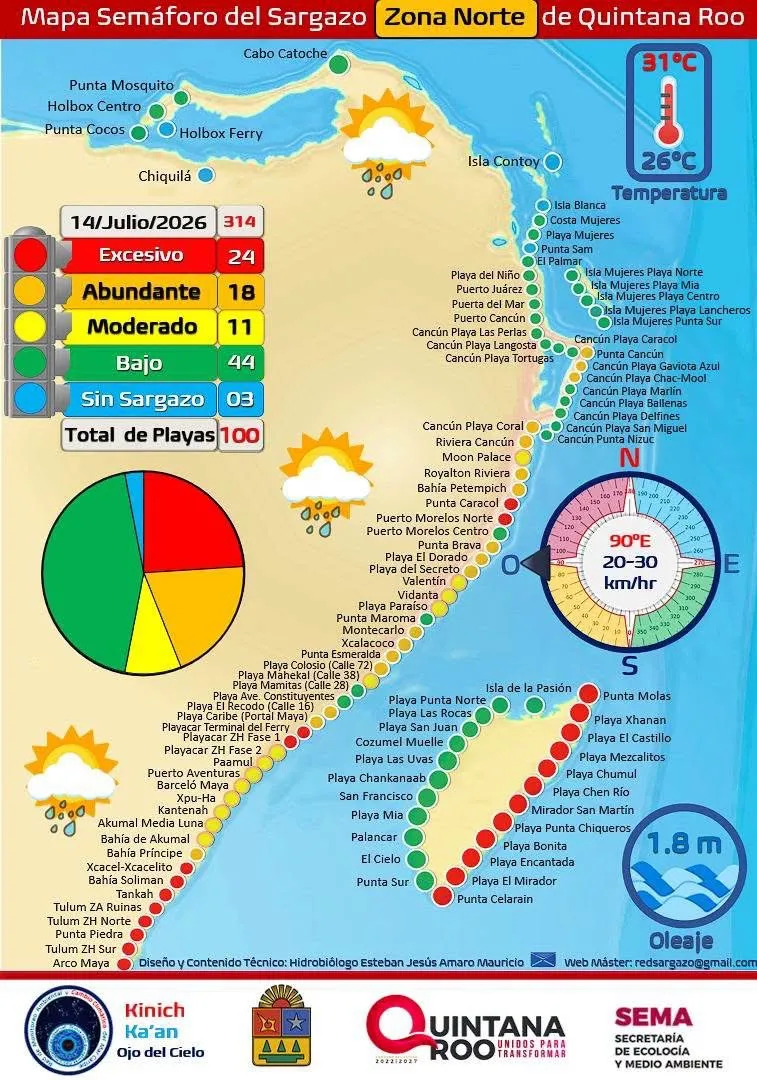
| Destination | Current status | My honest take |
|---|---|---|
| Playa del Carmen | Mixed: Mamitas and Constituyentes clean; Fundadores, El Recodo and Punta Esmeralda heavy | Stick to the Mamitas stretch - hotels clean it every morning at dawn |
| Cancún | Mostly clean (Delfines, Tortugas, Marlín, Ballenas) | The north-facing hotel zone dodges most of it |
| Isla Mujeres | Nearly all clean******** - ****Playa Norte spotless | One of the safest day trips during peak season |
| Cozumel | Practically the whole island clean, including Palancar and El Cielo | The west side (where everything is) almost never gets sargassum. My favorite plan B |
| Puerto Morelos | Patchy: town center clean, north end buried | Check the same day - it flips within a few kilometers |
| Tulum | 🔴 Critical: nearly the entire coast under excessive landings | If a perfect beach is your priority, Tulum is the wrong pick right now |
| Akumal / Xpu-Há | Moderate to heavy | Variable; Akumal bay gets cleaned because of the turtles |
| Holbox / Bacalar | Sargassum-free | Holbox faces the Gulf; Bacalar is a freshwater lagoon. Geographically immune |
The pattern worth memorizing: the east-facing mainland coast (Puerto Morelos down to Tulum) takes the direct hit, while the islands’ west sides (Cozumel, Isla Mujeres), north-facing beaches (Cancún, Holbox) and lagoons (Bacalar) almost always stay clean.
🔍 How to check beach conditions in real time
This is what I personally check before taking my family to the beach:
- The sargassum traffic light from the Quintana Roo Sargassum Monitoring Network (Red de Monitoreo del Sargazo - find it on Facebook): a daily map color-coding every beach from blue (clean) through green, yellow and orange to red (excessive). It’s the source local news outlets use.
- Sargazo.info: a Caribbean-wide beach directory with community reports and photos uploaded by people standing on the sand right now.
- Live webcams: several beach clubs and hotels in Playa del Carmen and Cancún run live cameras. Seeing the beach with your own eyes beats any forecast.
- Facebook groups and Instagram: Riviera Maya traveler groups post photos daily. Look for photos from the last 24 hours, not last week.
- Satellite bulletins: the University of South Florida publishes monthly outlooks showing how much sargassum is heading this way. Useful for planning weeks ahead.
My resident tip: check the traffic light the morning of, not the night before. A landing can arrive - or wash back out - overnight.
💦 Plan B: what to do when the sea turns brown
This is where living here changes your mindset: the ocean is just one of your options. These are my actual backup plans, from closest to farthest from Playa del Carmen:
Cenotes: the plan that never fails
Crystal-clear freshwater sinkholes with zero sargassum, guaranteed, always. Within 30 minutes of Playa del Carmen you have dozens: Cenote Azul and Cristalino (open-air, great with kids), Jardín del Edén, and the entire Ruta de los Cenotes out of Puerto Morelos. On heavy-landing days, a cenote is usually a better swim day than any beach.
👉 The Best Cenotes near Playa del Carmen Work in progress
👉 Prefer transport and a guide included? There are solid cenote day tours from Playa del Carmen: book here .
Beach clubs and hotel pools
Many Playa del Carmen beach clubs have oceanfront pools: you get the view, the breeze and the beach vibe without swimming through seaweed. Day passes at all-inclusive resorts are another strong option on bad days - pool, food and drinks all sorted.
The Cozumel ferry: my favorite escape
The ferry leaves from the pier in the middle of Playa del Carmen, and 45 minutes later you’re on an island where the west side - where all the beaches and clubs are - almost never sees sargassum. Palancar and El Cielo are often pristine even when Playa del Carmen wakes up orange on the traffic light.
👉 Ferry tickets and Cozumel snorkel tours .
Sargassum-free day trips
- Isla Mujeres: Playa Norte is one of the most sheltered beaches in the Mexican Caribbean.
- Holbox: faces the Gulf of Mexico, not the Atlantic. A different world.
- Bacalar: the freshwater “Lagoon of Seven Colors.” Sargassum is geographically impossible here.
🤝 My honest bottom line
Sargassum is real, it stinks, and it isn’t going away soon - it’s a symptom of planet-scale ocean imbalances, not one bad year. But after living here, I can tell you that the difference between a ruined vacation and a perfect one is information: knowing when to come, checking the traffic light each morning, and always having a plan B (this region has plenty).
If you’re visiting between December and February, you’ll probably never think about this article again. If you’re coming between May and August - bookmark it. You’ll use it.
Transparency: some links in this guide are affiliate links. If you book through them, I earn a small commission at no extra cost to you. I only recommend things I’d use with my own family.